How to Plan a Freshwater Community Tank Before Buying Fish
A practical stocking workflow that starts with adult size, social groups, water conditions, swimming zones, behavior, filtration, and a realistic maintenance plan.
By GuideMyTank Editorial Team · Published · Updated
A good community aquarium is designed backward from the adult animals, not assembled one attractive juvenile at a time. Every candidate contributes more than an inch of body length: it has a temperature range, water-chemistry preference, activity level, social requirement, feeding strategy, territorial pattern, waste load, and adult shape. The tank must satisfy the complete group at the same time. Compatibility is therefore a set of overlapping constraints, not a label attached to one species.
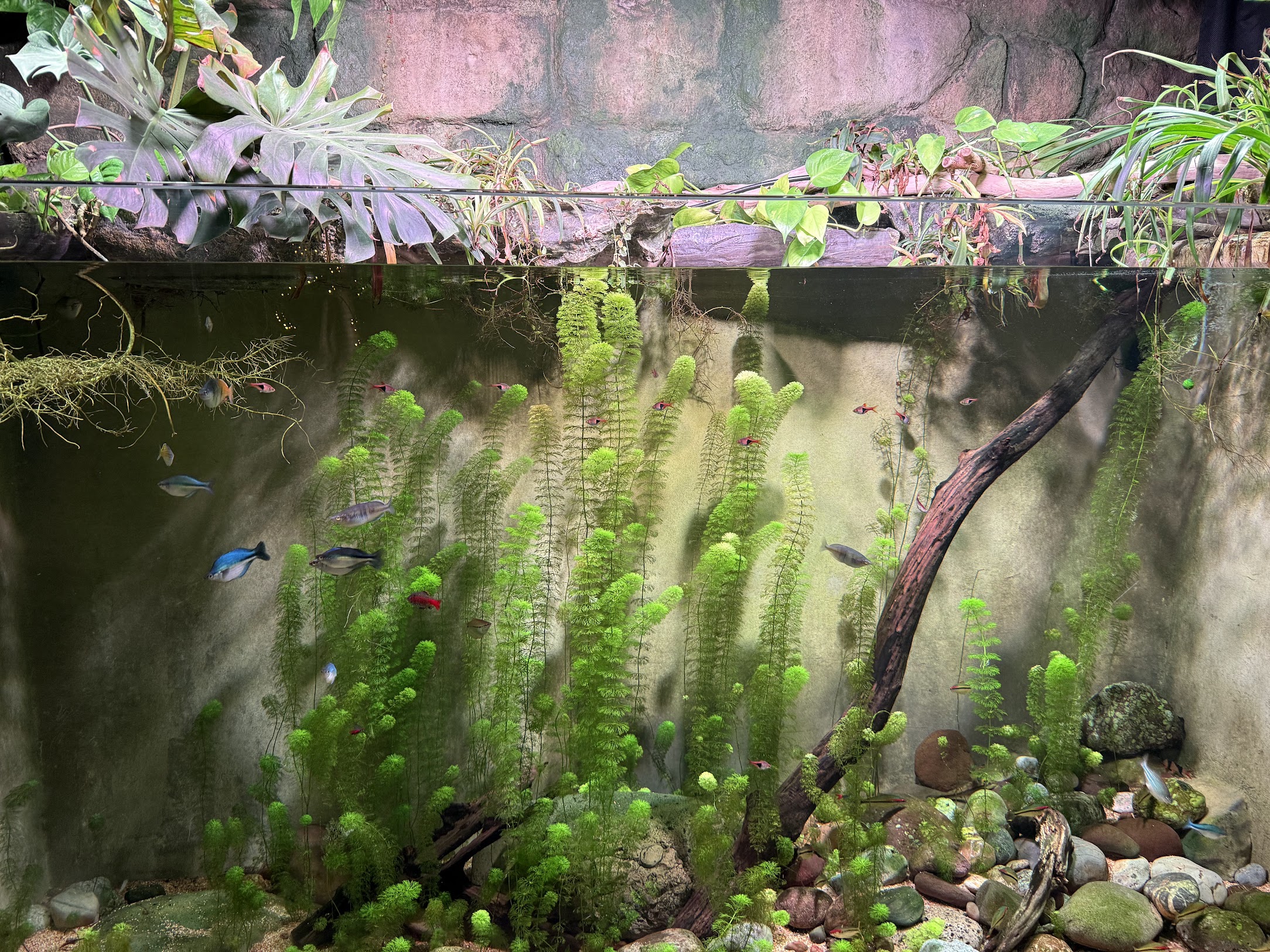
Image: Netha Hussain / Wikimedia Commons · CC0 1.0 Universal
Start with the aquarium’s fixed limits
Record the actual aquarium dimensions and water volume after substrate and hardscape are considered. Long, active swimmers benefit from horizontal distance; tall-bodied fish need vertical clearance; bottom groups compete for floor area even when open water remains above them. Confirm the filter’s operating needs, heater capacity, lid, flow pattern, and available electrical backup. Test the source water so the plan begins near conditions you can maintain consistently. Chasing an extreme pH with repeated chemical adjustments is usually less stable than choosing livestock suited to the available water.
Choose a focal requirement, not a shopping list
Begin with one species or one clear habitat goal. If the focal fish requires warm, soft water, every later candidate must fit that window. If it is a fast schooling fish, the aquarium needs adequate horizontal room and companions that tolerate the activity. If it is territorial, the plan must reserve defensible space and sight breaks. Starting with a constraint makes decisions easier because unsuitable options can be rejected early instead of rationalized after purchase.
Count complete social groups
Schooling and shoaling fish should be budgeted as groups from the beginning. A plan that has room for two corydoras but not an appropriate group does not truly have room for corydoras. The same principle applies to fish whose sex ratio affects harassment or reproduction. Livebearers may create an additional population plan: mixed-sex groups can produce fry, while poorly chosen ratios can concentrate attention on too few females. Social needs consume space and biological capacity before decorative variety is considered.
| Planning factor | Question to answer | Frequent mistake |
|---|---|---|
| Adult size | How large and what shape will every fish become? | Using store size as the final size |
| Social group | How many of the same species are needed? | Buying token pairs of schooling fish |
| Water overlap | Is there a stable shared temperature and chemistry window? | Aiming at opposite tolerance limits |
| Behavior | Who chases, guards, nips, hides, or hunts? | Treating peaceful as a guarantee |
| Tank zone | Is each swimming and resting zone crowded? | Assuming unused upper water creates more bottom space |
| Biological load | Can filtration and maintenance manage the complete group? | Using a single inches-per-gallon shortcut |
Use water ranges as an intersection
Two species are not a sound match merely because each can survive at one shared boundary value. Look for a practical overlap that leaves room for normal variation and supports long-term care. Temperature affects metabolism and dissolved oxygen, while pH, hardness, and alkalinity influence physiological stress and system stability. Keep the aquarium inside the shared recommended range rather than averaging incompatible requirements. When structured records are incomplete or sources disagree, treat uncertainty as a reason for more research, not permission to assume compatibility.
Check predation, aggression, and fin risk separately
Temperament labels compress complicated behavior. A fish called peaceful may still eat animals small enough to swallow, defend a cave, harass its own species, or outcompete slower fish at feeding time. Compare mouth and body size, adult size differences, activity, fin shape, territorial zones, breeding behavior, and known nipping tendencies. Then design cover and sight breaks without removing needed swimming area. A larger tank can reduce some conflicts, but volume does not erase a predator-prey relationship or incompatible social behavior.
Plan feeding before stocking
Community fish can share water while failing to share food fairly. Surface feeders may finish food before it reaches bottom dwellers. Shy fish may remain hidden while active fish monopolize every feeding. Algae grazers and detritus feeders still need a complete diet; they are not powered by aquarium dirt. Write down what each species eats, where it feeds, how often it should be observed eating, and how uneaten food will be controlled. Feeding access is part of compatibility because chronic underfeeding and excess waste both create health problems.
Add livestock in deliberate stages
- Finish cycling and confirm stable water before the first purchase.
- Quarantine new arrivals with separate equipment.
- Add one planned social group or modest load rather than the complete final list.
- Observe feeding, respiration, hiding, chasing, and water tests before the next addition.
- Recalculate the remaining plan after any substitution; one different species can change temperature, space, and behavior constraints.
- Stop stocking before the tank reaches a theoretical maximum so routine maintenance and unexpected growth remain manageable.
Do not use one inch of fish per gallon as a complete stocking rule. It ignores adult body mass, tank dimensions, social groups, activity, waste production, territorial behavior, filtration, and species compatibility.
A maintenance plan is part of stocking
A stocking list is only realistic if the keeper can maintain it. Estimate the time and water needed for regular changes, substrate cleaning where appropriate, plant care, filter maintenance, testing, and observation. Identify who can care for the aquarium during travel and what happens during a prolonged power outage. The strongest plan is not the list with the most species; it is the one that remains stable during ordinary life and makes abnormal behavior easy to notice.
Frequently Asked Questions
How many species should a community aquarium contain?
There is no universal number. Prioritize complete social groups and compatible requirements over variety. A tank with fewer well-supported species is usually easier to observe and maintain.
Does a larger aquarium make every pair compatible?
No. More space can help with dilution and some territorial behavior, but it cannot correct incompatible temperatures, predation, severe aggression, or unsuitable social structure.
Should bottom dwellers count toward stocking?
Yes. Every animal contributes waste and uses physical space, oxygen, feeding access, and maintenance capacity regardless of its swimming zone.
Sources and references
- The Ornamental Fish Trade: An Introduction with Perspectives for Responsible Aquarium Fish Ownership, University of Florida IFAS Extension
- Fish: Healthy Pets, Healthy People, Centers for Disease Control and Prevention
- Management of Aquarium Fish, Merck Veterinary Manual
Relevant Species
Related Care Guides
Bristlenose Pleco Care Guide
The Bristlenose Pleco (Ancistrus spp.), also known as the Bushynose Pleco or Bristlenose Catfish, is a peaceful freshwater catfish recognized by the distinctive bristles that develop around its snout. Smaller than many other plecos, they are popular community fish that spend much of their time grazing on surfaces and sheltering among driftwood, rocks, and caves. Bristlenose Plecos come in numerous species and aquarium-bred varieties, including Albino, Super Red, Calico, Longfin, and Black-Eyed Yellow forms. More specialized varieties include fish identified by L-numbers, such as the sought-after L183 Starlight Bristlenose (Ancistrus dolichopterus), along with L181, L182, and L184 Ancistrus. L-numbers are identification codes used in the aquarium hobby for loricariid catfish, particularly when a fish entered the trade before receiving a confirmed scientific name. An L-number therefore identifies a particular form or species and isn't simply a color or pattern designation. One thing I would not do in this guide is call the common Bristlenose itself “L144.” The original L144 designation referred to a particular wild form, while many yellow Bristlenose sold as “L144” today are actually captive-bred color strains.
Celestial Pearl Danio Care Guide
The Celestial Pearl Danio (Danio margaritatus) is a small, colorful freshwater fish known for its pearl-like spots, vivid red-orange fins, and peaceful nature. Native to shallow, heavily vegetated waters in Myanmar, these active nano fish thrive in planted aquariums and do best when kept in groups. Their striking appearance and manageable care requirements make them a popular choice for both beginner and experienced aquarists.
Guppy Care Guide
The Common Guppy (Poecilia reticulata) is a small, colorful freshwater fish known for its bright colors, active personality, and ease of care. Native to northeastern South America and parts of the Caribbean, guppies are highly adaptable and have become one of the most popular aquarium fish worldwide. They are peaceful, social livebearers that thrive in groups and work well in many community aquariums. Their hardiness and relatively simple care requirements make them an excellent choice for beginner aquarists.
Compatibility Research
Review these pair reports before planning a shared aquarium.
Celestial Pearl Danio and Bristlenose Pleco Compatibility
Research whether Celestial Pearl Danio and Bristlenose Pleco can share an aquarium.
Guppy and Bristlenose Pleco Compatibility
Research whether Guppy and Bristlenose Pleco can share an aquarium.
Guppy and Celestial Pearl Danio Compatibility
Research whether Guppy and Celestial Pearl Danio can share an aquarium.
Related Articles
A Practical Quarantine Routine for New Freshwater Fish
How to prepare and operate a simple quarantine aquarium, observe new fish, prevent cross-contamination, and decide when an animal is ready for the display tank.
How to Cycle a Freshwater Aquarium Without Sacrificing Fish
A test-driven explanation of freshwater aquarium cycling, what ammonia and nitrite results mean, and how to decide when a new tank is actually ready for livestock.